Thursday, November 7, 2019

Yeh-Shen: A Cinderella Story

Yeh-Shen: A Cinderella Story from China
By Ai-Ling Louie
Traditional Literature Book Blog
Illustrated by Ed Young
Published by Puffin Books
Text Copyright by Ai-Ling Louie
Images Copyright by Ed Young
32 pages
Genre: Children's Literature, Traditional, Multicultural Literature
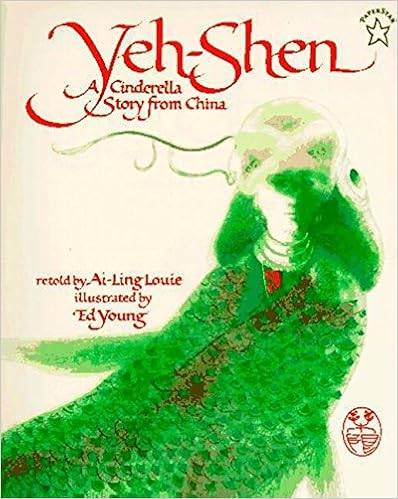
Yeh-Shen: A Cinderella Story from China is an adventurous, entertaining traditional tale based on Chinese culture. Though there are many elements of the American version of Cinderella in this story, the basis of this story is very different. Daughter of Chinese royalty, Yeh-Shen suffers many hardships following the death of her mother. When her father dies, she is forced to live with her harsh step-mother. Her only companion is a fish. Her companion is killed by her step-mother, but she soon realizes the bones of the fish are magic. She uses these bones to make her dream of attending the ball a reality. Yeh-Shen's story to become the Princess she is destined to be is made possible through many trials and triumphs. In the end, her destiny is complete and she becomes who she is meant to be. 

The illustrations in this book are made with a combination of different materials. The illustrator, Ed Young, utilizes watercolor to make the colors of the images come to life. His images are similar to those of traditional Chinese art. He also uses colored pencils to enhance his images and bring dimension into the characters. Throughout his different use of materials, Young creates traditional Chinese images that depict the story of Yeh-Shen accurately. 

Standard:
Grade: 3rd
Subject: English Language Arts
18 ) Compare and contrast the most important points and key details presented in two texts on the same topic. [RI.3.9]
After reading this version of the Cinderella story, I would then read the American version of Cinderella. After reading the two texts, I would engage my students in a discussion about the differences in cultures. We would then complete a compare and contrast chart in which we analyzed the two stories and presented the information we took away from each. This would give the students an opportunity to see the different in traditional literature and the many different adaptations that are produced from them. 

Hop on Pop!


Hop on Pop
By Dr. Seuss
Children’s Poetry Book
Illustrated by Dr. Seuss
Published by Random House Books for Young Readers
Copyright by Dr. Seuss
24 pages
Genre: Children’s Poetry Picture Book

This classic children’s books is notorious for its clever rhymes and hilarious story. Readers will love following along the rhyming words to see all the unusual characters in this book. Many funny situations occur throughout the story, serving to draw the young readers in and get them listening to what will happen next. This classic book will introduce readers to the rhyme of poetry in a funny, colorful way. 

The illustrations in this book are done from sketches made by the author illustrator. The dark lines the outline the images appear to be markers or pencil. The figures are colored in using either marker or pencil. Over the years, the images have been enhanced through the use of computer imaging. Overall, the colorful images and illustrations that are typical of Dr. Seuss stories are utilized to enhance this rhyming story. 

Standard: 
Grade: Kindergarten
Subject: English Language Arts
21. Demonstrate understanding of spoken words, syllables, and sounds (phonemes). 
A. Recognize and produce rhyming words. 

I would use this book to introduce a unit on rhyming words to a kindergarten class. We would read the book aloud during whole group instruction, and then we would go back over the words on the pages to identify the rhyming words. Since the words are fairly easy to decode, it would also be good to allow the students to sound out the words and decode the text. 


Biographies

Image result for biography clip art
Biography:
o What is a biography? A biography is a summary of someone’s life written by someone else. An autobiography is written by the person the biography is about.
o What is the value of a biography? Biographies serve to recount the events that occurred in someone’s life. Because they are written by someone else, they might serve to tell a different perspective of those events. Additionally, they are factual and focus on depicting what occurred during that person’s life.
o When did biographies become more appealing to young people? I believe that biographies become more interesting to young people when those readers are more interested in understanding the events of someone’s life. This typically occurs in the later school age years of children’s lives.
o In what ways were biographies made to be more acceptable to young people? In many ways, authors can make biographies more interesting to young people. They can be written on a younger level or in the form of a picture book. Additionally, biographies can feature colorful pictures or depictions of the people they are written about.


Categories of Biography Characteristics of category Example of category
Partial biographies Depicts only a segment of a person’s life
Explores that portion in depth “Why Don’t You Get a Horse, Sam Adams?”
Complete biographies The author recounts a person’s life from birth to the present or to the person’s death if he or she is no longer alive “Our Eleanor: A Scrapbook Look at Eleanor Roosevelt’s Remarkable Life”
Collective biographies A book describing the lives of several people who have something in common Uncommon Champions: Fifteen Athletes Who Battled Back
Autobiographies and Memoirs In an autobiography, a person writes about his or her own life.
A memoir differs from an autobiography in that it shares events from the author’s life based on his or her recollection.
A memoir often focuses on one particular event or time in the person’s life and reflects on the meaning of that event for the author. “Drawing from Memory”
“To Dance: A Ballerina’s Graphic Novel”

Criteria for evaluating biography:
o Is the person someone whose life will be of interest to young readers?
o Has the author presented the person in such a way that readers can identify with him or her as an authentic, believable human being?
o Is the information about the person accurate and authentic?
o Has the author written in an engaging style that maintains the readers’ attention?